By May, most people strategies are already drifting. The carefully crafted roadmap from January is now competing with a hiring freeze, a surprise restructure, and a manager who hasn't had a proper one-on-one with their team in three months. The plan hasn't failed. It's just lost its footing, and without a deliberate mid-year pause, it won't find it again until Q4, when course-correcting costs twice as much effort and twice as many people.
This is your structured mid-year pause. Think of it as not just a reflection exercise, but a diagnostic. Here's how to run it.
The 4 Metrics Worth Revisiting Right Now
Before you can course-correct, you need an honest read on where things stand. Pull these four numbers and resist the urge to explain them away before you've looked at them clearly:
-
Turnover rate vs. target
- Time-to-fill
- Q1 engagement scores
- Absenteeism trends
Turnover above target is rarely just a compensation story. Dig into whether it's concentrated in specific teams, tenure brackets, or manager spans. Time-to-fill creeping upward often signals a sourcing problem, but sometimes it's a decision-making problem that's downstream of unclear role design.
Engagement scores from Q1 are already dated; if they were low, ask what's actually changed since. And absenteeism spikes are frequently the first warning sign for burnout before they become voluntary exits.
The teams with the clearest picture right now aren't necessarily the ones with better outcomes. They're the ones with more frequent data. When feedback is continuous rather than annual, you're looking forward, not backward.
Teams using continuous engagement and feedback tools have a structural advantage here. Instead of relying on an annual engagement survey that captures a moment in time, they've been accumulating signals all year, which means their Q2 review isn't a scramble for data.
Did Your Manager Enablement Hold Up?
Most people strategies live or die at the manager layer. You can design the best framework in the business, but if it isn't translating into actual conversations between managers and their direct reports, your people strategy is just words on a paper.
To see how your strategy is holding up, ask these three questions:
Are managers having the conversations they're supposed to? Not the formal review conversations. The frequent, lower-stakes check-ins that build the psychological safety for harder discussions later. If your answer is anything but yes, that's a gap.
Are escalations up or down? An increase in ER caseload is sometimes a sign that managers are doing the right thing and surfacing issues early. More often, it signals that issues are going unaddressed at the team level until they become something an HR business partner has to handle.
What patterns are emerging? If the same managers keep appearing in your dashboard diagnostics, you have a coaching opportunity or a capability gap. Either way, it needs to be named.
Continuous feedback data makes this diagnostic far more concrete. You can see whether manager-employee dialogue is actually happening on a consistent cadence, rather than inferring it from sentiment surveys or relying on what managers self-report in your HRBPs' one-on-ones with them.
The AI Commitments You Made in January (Be Honest)
Almost every HR team set some version of an AI adoption goal at the start of 2026. Upskilling programs, workflow automation, AI-assisted recruitment. Some of those commitments have moved forward. Many have stalled quietly, with no one quite willing to call it.
The mid-year check-in is the moment to be honest about the gap between ambition and implementation. Not to assign blame, but to understand it. Common culprits include:
- The rollout was planned without first understanding actual workforce readiness.
- Tool adoption was tracked by license usage rather than meaningful integration.
- Managers were expected to champion change while simultaneously navigating everything else on their plates.
You cannot close an AI readiness gap you haven't accurately measured. Assumptions and anecdotal manager feedback are not measurement.
If you haven't run a structured assessment of where your workforce actually is on AI adoption and confidence, do it now, not in September. An AI readiness survey gives you the ground truth: which functions are genuinely integrating AI into daily work, where discomfort or distrust is acting as a blocker, and where the skills investment needs to go in H2. Based on real data, not just where you hope your people are at.
Your Mid-Year Correction Playbook
If the diagnostic has surfaced issues, and it almost certainly will have surfaced at least one, here are three actions worth prioritizing in Q3.
Reprioritize headcount plans. The business conditions you were planning against in January have probably shifted. Rather than defending the original plan, work with your finance and business partners to remodel headcount based on what the business actually needs now. Where are the critical gaps? Where are you carrying capacity you won't use?
Revisit onboarding for H2 hires. Second-half hires often get a lighter version of onboarding because the infrastructure built for the January intake isn't scaled back up. If you're bringing people in during Q3 and Q4, now is the time to audit the experience.
Flag retention risks before they become resignations. The regrettable attrition that will hit you in Q4 is already forming now. With HR tech platforms, like LutherOne, you can predict attrition up to 14 months in advance, allowing you to course-correct before the resignation letter crosses your desk. .
The mid-year review doesn't need to be a crisis response. Done well, it's the moment you turn a drifting strategy back into a deliberate one, with enough runway in the second half of the year to make it matter.
Want to Know Where Your Strategy Stands?
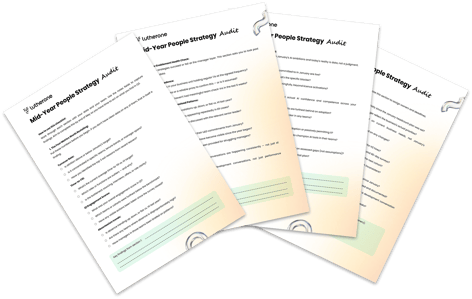
Download our Mid-Year People Strategy Audit. This FREE checklist gives HR leaders a structured, section-by-section audit to know where your strategy is driving results, and where it's drifting, giving a clear roadmap of things to fix before Q3 hits.